 UK: 020 8146 3222
 info@imperialintelligence.co.uk
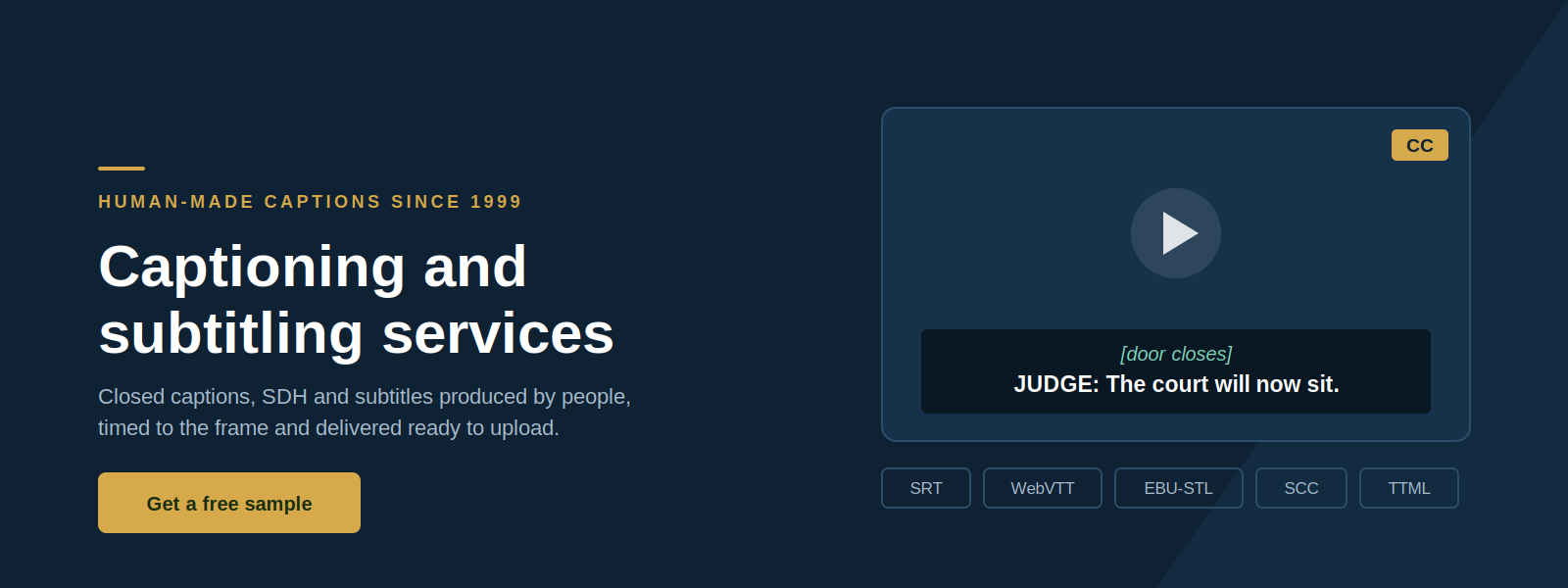
Human-made captions and subtitles for broadcast, education, legal and corporate video. Accurate, correctly timed, and delivered in the format your platform expects.
Automatic captions get roughly the right words in roughly the right place. That is not enough when the video carries a lecture, a hearing, a patient briefing, or a brand. Imperial Intelligence has been producing written records of spoken material since 1999, and our captioning work is built on the same discipline: a trained specialist listens to every second, decides what matters, times it to the frame, and takes responsibility for the result. No automated first pass. No cleanup cycle handed back to you.
Captions, subtitles and SDH — what you actually need
These three terms get used interchangeably, and ordering the wrong one costs time. Here is the practical difference.
Subtitles carry the dialogue only. They assume the viewer can hear the audio and simply needs the words on screen — for clarity, for noisy environments, or because the speech is in another language.
Closed captions carry the dialogue plus everything else a hearing viewer receives: speaker identification, relevant sound effects, music cues, tone. They are called “closed” because they sit in a separate file and the viewer turns them on. This is the format most accessibility obligations refer to.
Open captions contain the same information but are burnt permanently into the picture. Nobody has to switch them on, which is why they dominate social video, and nobody can switch them off, which is why they are rarely used for broadcast.
SDH (Subtitles for the Deaf and Hard of Hearing) is the format broadcasters and streaming platforms request. It combines caption-level information with subtitle-style presentation and follows strict positioning, reading-speed and line-break rules.
What we caption
- Broadcast and VoD — programmes, documentaries, series and inserts prepared to UK broadcast conventions
- Higher and further education — lectures, seminars, MOOCs and recorded assessments
- Healthcare and clinical — training material, patient information, conference recordings
- Legal and compliance — hearings, depositions, evidential video, internal investigations
- Corporate — town halls, all-hands recordings, internal training, investor material
- E-learning and course platforms — modules built for Moodle, Canvas, Blackboard, Thinkific and similar
- Marketing and social — burnt-in captions sized for LinkedIn, YouTube, Instagram and TikTok
- Live captioning — Zoom, Microsoft Teams, Google Meet and Webex sessions, plus in-room events
Delivery formats
We supply caption and subtitle files ready to upload, not raw text you have to convert.
| Use case | Formats we deliver |
|---|---|
| Web and online video | SRT, WebVTT |
| Broadcast (UK/EU) | EBU-STL, EBU-TT |
| Streaming and OTT | TTML, DFXP, iTT |
| US broadcast | SCC, CAP |
| Burnt-in / open captions | Rendered MP4 or MOV |
| Editorial and archive | DOCX, PDF, timestamped transcript |
Positioning, colour coding for speaker changes, reading-speed limits and line-break conventions are applied to your house style or to the standard your platform enforces. If you work to a template, send it and we will match it.
Accessibility and compliance in the UK
Captioning is rarely just an editorial preference. Depending on who you are, it may be a legal obligation.
Broadcasters work to Ofcom’s Code on Television Access Services, which sets subtitling quotas by channel and expects a defined standard of accuracy, timing and presentation. The BBC Subtitle Guidelines are the reference most UK production teams work to in practice.
Public sector organisations — including universities, NHS trusts, councils and government bodies — fall under the Public Sector Bodies (Websites and Mobile Applications) Accessibility Regulations 2018, which point to WCAG conformance at level AA.
Everyone else sits under the Equality Act 2010, which requires reasonable adjustments so that deaf and hard-of-hearing people are not placed at a substantial disadvantage.
The two WCAG criteria that matter most for video are 1.2.2 Captions (Prerecorded) at level A and 1.2.4 Captions (Live) at level AA. Auto-generated captions routinely fail both, because the criteria require captions to be accurate, not merely present.
We produce captions that stand up to an accessibility audit, and we are happy to talk to your compliance or disability services team directly.
Why human captioning still wins
Speech recognition has improved. It has not solved the things that break captions.
- Names and terminology. Case names, drug names, product names, place names, acronyms. An engine guesses phonetically; a specialist checks.
- Overlapping speakers. Panel discussions, cross-talk, interruptions. Automation flattens these into one unattributed stream.
- Accents and dialect. Regional UK speech, second-language speakers, code-switching.
- Sound that carries meaning. A pause. A laugh. A door closing. A phone ringing off-screen. Captions exist so that a deaf viewer receives the same information as everyone else, and half of that information is not words.
- Reading speed. Correct text presented too fast is still inaccessible. Line breaks, splits and durations are editorial decisions.
- Confidentiality. Files handled under GDPR-aligned workflows and signed confidentiality agreements — not uploaded to a third-party engine you have no contract with.
We do not use AI or automated transcription engines to generate output. Technology supports our secure workflow; it does not replace the person accountable for your file.
How it works
1. Send the file. Upload through our secure portal, encrypted email, or a cloud link. Tell us the target format, turnaround and any style requirements.
2. Assignment. A team lead allocates the project to a captioner with relevant subject experience — legal, medical, academic or media.
3. Captioning and timing. Transcription, speaker identification, sound description, then frame-accurate timing and line-break decisions.
4. Quality check. A quality analyst reviews the file line by line against your spec and the applicable standard.
5. Delivery. Caption files in every format you asked for, ready to upload. Revisions if anything needs adjusting.
Turnaround and Captioning pricing
Captioning is priced per minute of source media. Rates depend on turnaround, number of speakers, audio quality, target formats and whether translated subtitles are required. Send us a sample file and we will return a fixed quote and a free trial section so you can judge the quality before committing.
Captioning services near you
Our captioning team works remotely across the UK, which means location is not a constraint — files are collected, produced and delivered securely online, wherever you are. Our UK office is at One Canada Square, Canary Wharf, London, and we work with clients in London, Manchester, Birmingham, Leeds, Glasgow, Edinburgh, Bristol and Cardiff, as well as across Europe and the United States from our New York office.
FAQ
What is the difference between captions and subtitles? Subtitles show dialogue only and assume the viewer can hear. Captions include dialogue plus speaker identification and non-speech sound, so a deaf or hard-of-hearing viewer receives the same information as a hearing one.
Do you provide SDH subtitles? Yes. We produce SDH to broadcast and streaming conventions, including speaker identification, sound description, positioning and reading-speed limits.
Which caption file formats do you deliver? SRT, WebVTT, EBU-STL, EBU-TT, TTML, DFXP, iTT, SCC and CAP, plus burnt-in open captions and timestamped transcripts. If your platform needs something else, ask.
Can you caption live meetings and events? Yes. We provide live captioning for Zoom, Microsoft Teams, Google Meet and Webex sessions, and for in-person events. Live work needs to be booked in advance so we can assign the right captioner.
Do you use AI or automatic captioning? No. Every caption file is produced by a trained human captioner and reviewed by a quality analyst. Technology supports our secure workflow, not the output itself.
Will your captions meet accessibility requirements? Our captions are produced to meet WCAG 1.2.2 and 1.2.4 and are suitable for organisations working under the Equality Act 2010 or the public sector accessibility regulations. Broadcast work is prepared to UK subtitling conventions.
How accurate are your captions? Files are transcribed and then checked line by line against the audio before delivery. Where audio is unclear or a term is genuinely ambiguous, we flag it rather than guess.
Can you handle poor-quality or multi-speaker audio? Yes. Background noise, overlapping speech, strong accents and remote-recording artefacts are routine for our team. Clearer audio always produces a better result, but difficult recordings are exactly where human captioning earns its place.
Can you produce subtitles in other languages? Yes. Translated subtitles are handled by human linguists working into their native language, with the same timing and presentation standards.
How do I send files securely? Through our encrypted portal, secure email, or an approved cloud link. All work is covered by GDPR-aligned handling and confidentiality agreements.
How quickly can you turn work around? We offer standard and priority turnaround. Timescales depend on runtime, speaker count and format, and we confirm a delivery time with your quote.
Do you offer a free trial? Yes. Send a short sample and we will caption it at no cost so you can assess quality before placing an order.
Related Services:
 Typing Services Near You — UK Typists, Documents Back Fast
 Healthcare Transcription Services
 Language Transcription Services
 Radiology Transcription Services (Imaging Dictation to Structured Reports)
 qualitative research transcription services
 Transcription Services Company
 Best Podcast Transcription Service
 Certified Transcription Services
 Digital Transcription Services
 Insurance Transcription Services
 Podcast Transcription Services
 YouTube Video Transcription Service UK
 Conference Call Transcription Service
 Finance Transcription Service
 Market Research Transcription Services

