 UK: 020 8146 3222
 info@imperialintelligence.co.uk

Most insurance claims are decided on paper. But the moment a claim turns contentious, the paper is rarely where the truth sits. It sits in a forty-minute phone call recorded at first notification of loss, in a loss adjuster’s interview conducted in a claimant’s kitchen, in a field investigator’s recorded statement taken eight months after the accident.
That audio is often the most honest evidence in the file. It is also the least usable — until somebody turns it into an accurate, defensible written record.
This is where transcription stops being an administrative task and becomes an evidential one.
The audio in a modern claims file
Claims teams are sitting on far more recorded material than they were even five years ago. A single disputed motor or liability claim can generate:
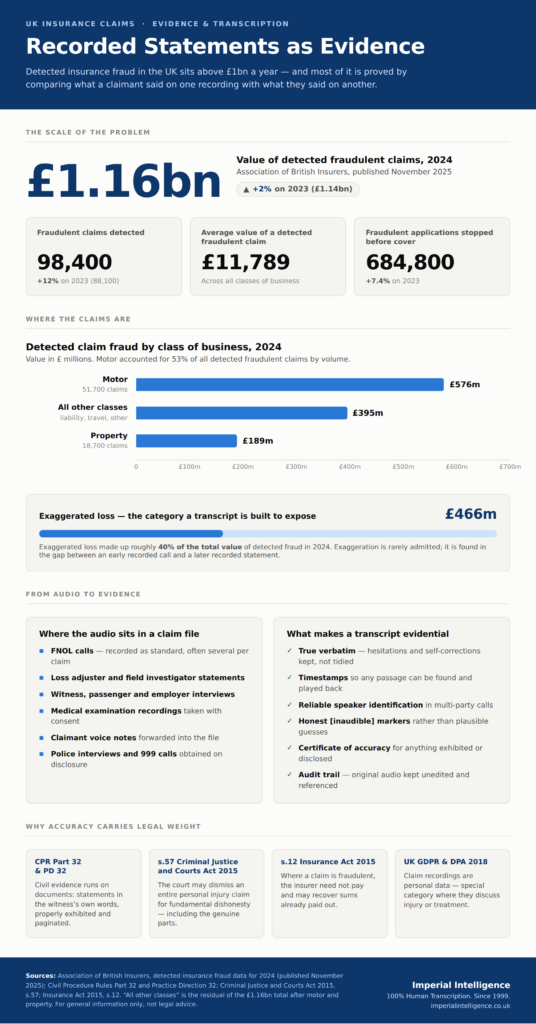
- First notification of loss (FNOL) calls, often several, recorded as a matter of course
- Recorded statements taken by loss adjusters, field investigators or in-house counter-fraud teams
- Telephone interviews with witnesses, passengers, neighbours or employers
- Medical examination recordings, where the claimant has consented
- Voice notes, sent by claimants over WhatsApp and forwarded into the file
- Dashcam and body-worn footage with usable audio
- Police interviews under caution and 999 call recordings obtained through disclosure
None of it is evidence in a practical sense while it remains an audio file on a claims system. A district judge is not going to sit and listen to three hours of recordings. Counsel cannot cross-examine on a timestamp they have to hunt for. And an insurer’s own file reviewer, six months into the claim, will not re-listen to everything before making a reserve decision.
Why the recording alone is not enough
Civil evidence in England and Wales runs on documents. Part 32 of the Civil Procedure Rules and its accompanying Practice Direction set out how factual evidence is put before the court: witness statements in the witness’s own words, exhibits properly identified, everything paginated and sitting in a bundle the judge can navigate.
An audio file does not fit that machinery. A transcript does.
When a recorded statement is transcribed properly, it becomes something you can quote in a defence, exhibit to a witness statement, put to a claimant in cross-examination, and hand to a medico-legal expert who needs to know exactly what the claimant said about their symptoms in month two versus month nine.
When it is transcribed badly, it becomes a liability. Which brings us to the part of this that costs insurers money.
Inconsistency, fundamental dishonesty and the transcript
Counter-fraud work is essentially the business of comparing what somebody said on one occasion with what they said on another.
The scale is not trivial. The Association of British Insurers recorded 98,400 detected fraudulent claims worth £1.16 billion in 2024, with an average value of £11,789 — and motor claims made up 53% of them. Exaggerated loss alone accounted for £466 million.
Exaggeration is not usually discovered through a dramatic confession. It is discovered in the gap between an FNOL call where a claimant says they carried on to work and a later statement in which they could not get out of bed for a fortnight. That gap only becomes an argument you can run when both accounts exist as accurate, timestamped text that can be set side by side.
The stakes are meaningful. Section 57 of the Criminal Justice and Courts Act 2015 allows the court to dismiss an entire personal injury claim where the claimant has been fundamentally dishonest, including the parts that were genuine. Section 12 of the Insurance Act 2015 gives insurers remedies where a claim is fraudulent, including recovery of sums already paid. Both are powerful. Both depend on being able to demonstrate, precisely and in writing, what the claimant actually said.
“Fundamentally dishonest” is a finding a judge makes on evidence. A paraphrased summary written up from memory by a busy investigator is not that evidence. A verbatim transcript is.
What an evidential-quality transcript actually looks like
There is a real difference between a transcript produced for internal convenience and one produced to be relied on. For claims and litigation work, the standard should include:
True verbatim, not tidied prose. Hesitations, false starts, self-corrections and repetitions matter. A claimant who says “I fell — well, I sort of slipped, then I fell” has told you something that “I fell” does not. Cleaning that up destroys the evidence.
Timestamps at meaningful intervals. So a passage can be found and played back in seconds, whether by counsel, an expert or the court.
Reliable speaker identification. Three-way calls with a claims handler, a claimant and a family member prompting from the background are common, and attributing an admission to the wrong person is a serious error.
Honest [inaudible] markers. A good transcriber flags what could not be heard, with a timestamp. A guess dressed as a certainty is far more dangerous than an acknowledged gap.
Non-verbal and contextual notes. Long pauses, laughter, a third party interrupting, background noise that explains why a passage is unclear.
A certificate of accuracy and a clear audit trail. For anything heading towards a court, a tribunal or the Financial Ombudsman Service, certified transcription with a signed statement of accuracy removes an easy line of attack on your evidence.
The problem with running claim audio through automated tools
Automated speech recognition has improved, and for low-stakes internal note-taking it has its place. Evidence is not low-stakes, and there are three specific reasons claims teams get burned.
It fails exactly where claims are decided. Regional accents, two people talking over each other, a poor mobile line from a car, medical and legal terminology, unfamiliar place names — these are the ordinary conditions of a recorded statement, and they are the conditions in which error rates climb. Worse, the errors that matter most are usually the smallest: a registration plate, a date, a figure, a dosage, a “did not” heard as “did”.
Machine output reads as confident whether or not it is right. An automated system rarely tells you it was unsure. It produces fluent, plausible text, and a fluent error is far harder to catch on review than an obvious one. If you disclose a transcript and the other side plays the recording to show your document is wrong, you have handed them a free attack on the credibility of your entire file.
Data protection. A recorded statement is personal data, and where it discusses injuries or treatment it is special category data under the UK GDPR. Uploading claimant audio into a consumer AI transcription tool, with unclear retention terms and unclear processing locations, is a genuine compliance exposure — not a theoretical one. Claims data belongs in a workflow with a proper processing agreement, defined retention and controlled access.
This is why Imperial Intelligence has stayed with 100% human transcription since 1999. A trained transcriber who works in legal and insurance material recognises when something matters, listens to a difficult passage five times, and flags the twelve seconds that could not be resolved rather than inventing them.
Recorded statements, subject access and disclosure
There is a second reason to keep good transcripts, and it has nothing to do with fraud.
Claimants and their solicitors increasingly request recordings. A recorded call is the claimant’s personal data, and a subject access request will capture it. The Information Commissioner’s Office has publicly criticised insurers over their handling of subject access requests, and the practical burden of responding to one across dozens of audio files is considerable.
Working from transcripts changes that job entirely. Text can be searched, reviewed, redacted for third-party personal data, and released in a form both sides can reference by page and line. It also protects consistency: the version of the statement your file reviewer relied on, the version your solicitor pleaded from and the version disclosed to the claimant are all the same document.
A practical checklist for claims and defence teams
- Transcribe recorded statements early, not on the eve of a hearing when turnaround pressure invites shortcuts
- Insist on true verbatim with timestamps for anything potentially contentious
- Order certified transcription for material likely to be exhibited or disclosed
- Keep the original audio unedited and referenced against the transcript, so provenance is never in question
- Have inconsistencies identified from text, not from memory of a call
- Confirm your transcription provider’s UK GDPR position, retention policy and confidentiality obligations before sending claimant audio
- Use one provider consistently, so conventions and formatting do not vary across a file
Frequently asked questions
Is a transcript of a recorded statement admissible in court in the UK? A transcript is generally put before the court as a record of the recording, with the audio available as the primary evidence. Accuracy is therefore critical, and a certificate of accuracy from the transcriber strengthens the position considerably. The court retains discretion over the admission of evidence.
Verbatim or intelligent verbatim for insurance claims? True verbatim for anything contentious, investigative or heading towards litigation, because hesitation and self-correction carry evidential weight. Intelligent verbatim is acceptable for internal summaries and routine file notes.
Can you transcribe poor-quality claim recordings? Usually, yes. Difficult mobile-line calls, background noise, strong accents and multi-speaker interviews are routine work for experienced human transcribers. Anything genuinely unclear is flagged with a timestamp rather than guessed at.
How is confidentiality handled for claimant data? Through a UK GDPR-compliant workflow: named transcribers under confidentiality obligations, secure transfer, restricted access and a defined retention policy. Claims audio is never processed through public AI platforms.
How quickly can a recorded statement be transcribed? Same-day and overnight options are available where a claim decision, limitation deadline or hearing date requires it.
Turning claim audio into evidence you can rely on
A recorded statement is only as useful as the record you make of it. Get that record right and you have a document that supports a repudiation, defeats an exaggerated claim, or answers a subject access request cleanly. Get it wrong and you have created a problem inside your own file.
Imperial Intelligence has provided legal transcription and investigative transcription since 1999, including police interview transcription and court-ready documents for law firms and insurers. Every transcript is produced by a human specialist and delivered ready to use.
Talk to us about your claims transcription requirements — or call 020 8146 3222.
Related Services:
 Captioning and subtitling services
 Digital Transcription Services
 Healthcare Transcription Services
 Insurance Transcription Services
 Podcast Transcription Services
 Script Transcription Services
 YouTube Video Transcription Service UK
 Zoom Transcription Services
 Cheap Transcription Service
 Chinese Transcription
 Conference Call Transcription Service
 doctor dictation transcription services
 Finance Transcription Service
 Korean Transcription Services
 Market Research Transcription Services

