 UK: 020 8146 3222
 info@imperialintelligence.co.uk
The short answer: AI has already replaced a large share of routine dictation typing, and it will keep taking more of it. What it has not replaced is the person who checks the record before it becomes part of a patient’s history and in July 2026 UK regulators made that checking step an explicit legal expectation. The job is contracting and changing. It is not disappearing.
That is the honest version, and it is worth having in full, because most articles on this question are written either by people selling AI scribes or by people selling transcription. Here is what the evidence actually shows.
What AI has genuinely taken over
There is no point pretending otherwise. Speech recognition crossed a real threshold, and the work it now does perfectly well includes:
- Straightforward dictation, recorded on decent equipment, by a clinician with a clear voice and a consistent style
- First drafts of routine clinic letters that follow a house template
- Real-time note drafting during a consultation, through ambient voice technology that listens to the room
- Search and retrieval across large volumes of recorded material
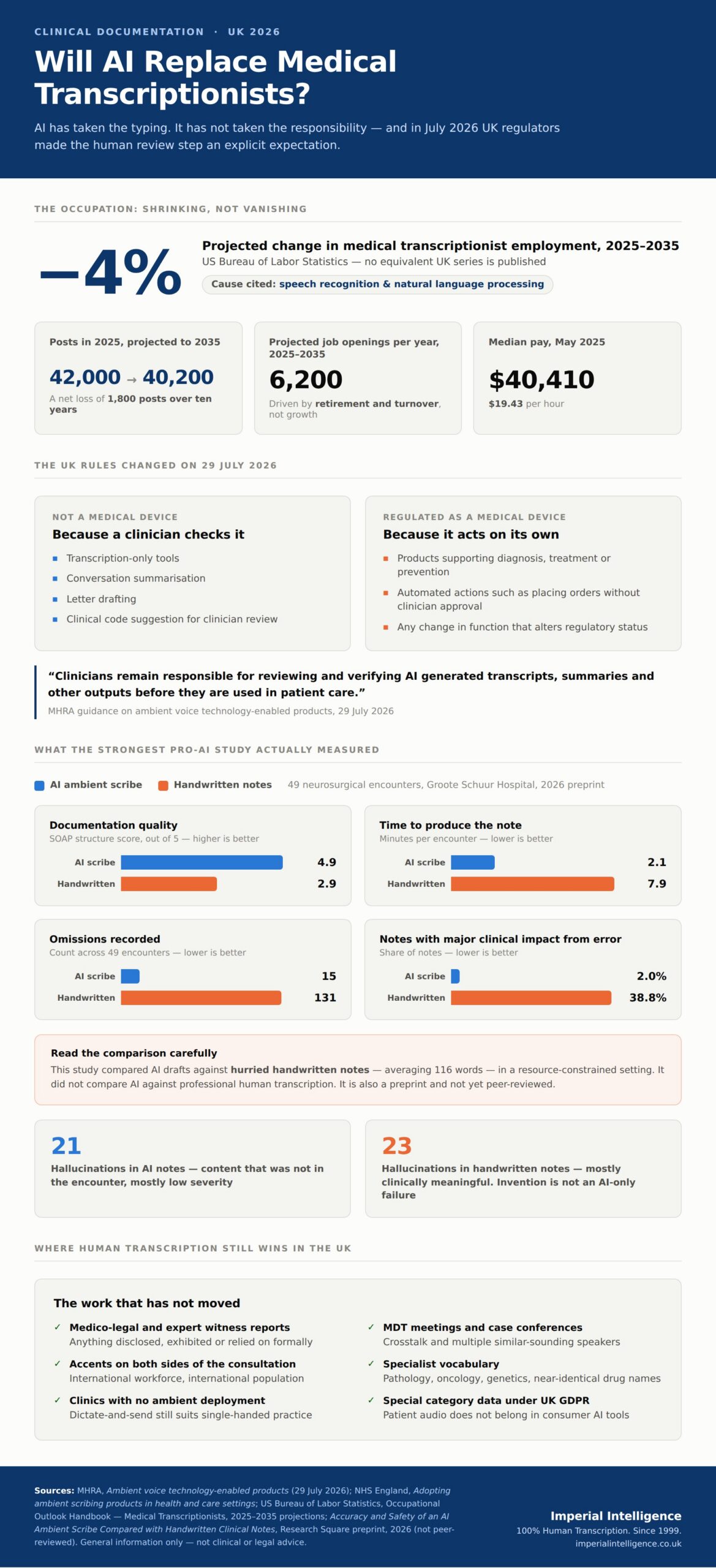
The US Bureau of Labor Statistics projects employment of medical transcriptionists to fall by 4% between 2025 and 2035, from around 42,000 posts to 40,200, and names speech recognition and natural language processing as the cause. That is a real decline and anyone who tells a trainee otherwise is doing them no favours.
But look at the second number in that same projection: roughly 6,200 openings a year across the decade. A shrinking occupation with thousands of annual vacancies is not an occupation being replaced. It is one being reshaped.
What the clinical evidence shows and what it does not
The strongest recent data point for AI scribes comes from a 2026 preprint out of Groote Schuur Hospital in South Africa, which compared an ambient AI scribe against handwritten notes across 49 neurosurgical encounters. The AI notes scored 4.9 out of 5 on SOAP structure against 2.9 for handwritten, took 2.1 minutes to produce rather than 7.9, and carried far fewer omissions 15 against 131. Major clinical impact from documentation error appeared in 2% of AI notes against 38.8% of handwritten ones.
Those are striking figures, and they deserve to be taken seriously. Two caveats deserve equal weight.
First, the comparison is against hurried handwritten notes in a resource-constrained setting, not against professional transcription. AI comfortably beating a rushed 116-word scribble tells you very little about AI beating a trained transcriptionist working from the same audio. Different question, different answer.
Second, the AI still produced 21 hallucinations content that was not in the encounter. They were mostly low-severity in this study, and the authors fairly note that hallucinations were not unique to the AI. But they existed, in a clean study, under observation. In routine practice, nobody is grading them.
This is the point that gets lost. The realistic question was never “is AI accurate?” It is “who catches it when it isn’t, and how much does that person cost?”
The regulatory turn: the UK just answered that
On 29 July 2026 the MHRA published guidance clarifying the regulatory status of ambient voice technology in the NHS, and NHS England updated its ambient scribing guidance to align with it.
The headline was read as permissive. Transcription-only tools, conversation summarisation, letter drafting and clinical code suggestion are not regulated as medical devices, provided a clinician reviews the output. Products that support diagnosis or treatment, or that take automated action such as placing an order without approval, are regulated and must meet device requirements.
Read the condition rather than the headline. The reason those tools stay outside device regulation is precisely that a human is expected to check them. The MHRA is direct about it: clinicians remain responsible for reviewing and verifying AI-generated transcripts, summaries and other outputs before they are used in patient care.
NHS England’s adoption guidance carries the same shape. Organisations are expected to complete a data protection impact assessment, work through local clinical governance and training, and consult the AVT Supplier Registry while NHS England explicitly does not endorse any supplier on it. The framing throughout is a draft “for review and validation”.
So the verification work has not been automated away. It has been moved from a trained documentation specialist to the clinician, who is the most expensive and most time-pressured person in the building.
The saving that quietly disappears
Practices adopt ambient scribing to give clinicians their evenings back, and for many that genuinely works. But the business case is usually built on the time the AI saves and rarely on the time the review costs.
If a consultant spends three or four minutes per encounter reading a generated summary properly checking laterality, checking the drug and the dose, checking that a negative has not become a positive, checking that nothing has been invented then across a full clinic that is not a marginal cost. And if they don’t spend those minutes, the practice has quietly accepted an unreviewed AI document into the patient record, which is exactly the position the MHRA guidance is written to prevent.
There is a third option, which is the one the industry is converging on: let the machine draft, and put a trained human between the draft and the record. That is not a rejection of AI. It is the workflow the regulator is describing.
Where human medical transcription still wins in the UK
Some work has not moved and shows little sign of moving:
Medico-legal reports and expert witness work. Anything that may be disclosed, exhibited or relied on in proceedings needs an accuracy standard that will survive challenge, often with certified transcription. An unverified machine transcript in a court bundle is a liability, not a document.
Multi-speaker audio. MDT meetings, case conferences, board rounds and research interviews involve crosstalk, interruption and several people who sound similar. This is where automated speaker attribution fails, and attributing a clinical decision to the wrong consultant is a serious error.
Accents on both sides of the consultation. UK healthcare is delivered by an international workforce to an international population. Regional British accents, non-native English, interpreter-mediated consultations and patients who are elderly, distressed or unwell are the ordinary conditions of a clinic and they are the conditions in which machine error rates climb.
Specialist vocabulary. Pathology, oncology, radiology, genetics and rare-disease terminology, drug names that differ by a syllable, and eponymous conditions. The errors that matter here are small: a dose, a laterality, a negation, a single digit.
Practices without integration. Plenty of private clinics, chambers and single-handed consultants have no ambient scribing deployment and no appetite for one. Dictate-and-send still suits them, and outsourced medical transcription remains the cheaper answer than hiring.
Anything with a data protection problem. Patient audio is special category data under the UK GDPR. Routing it through a consumer AI tool with unclear retention and unclear processing locations is not a shortcut; it is an incident waiting to be reported.
What the job becomes
The medical transcriptionist who only types is in a shrinking role. The one who edits, verifies and takes responsibility for a document is in a growing one.
The skills that matter now are less about words per minute and more about knowing what should be in a note and noticing when it isn’t recognising that a stated dose is implausible, that a laterality is inconsistent with the rest of the letter, that a summary has confidently asserted something the clinician never said. That is clinical documentation judgment, and it is the part speech recognition does not have.
It is also why Imperial Intelligence has held to 100% human transcription since 1999. Not because the technology is useless it plainly is not but because the responsibility for what ends up in a patient’s record is not something you can outsource to a model. Someone has to own it.
Frequently asked questions
Will AI replace medical transcriptionists completely? Not on current evidence. Routine dictation typing is being automated and the occupation is projected to shrink modestly, but the review and verification step is expanding, and UK regulators now expect a human to perform it before AI output is used in patient care.
Are AI medical scribes regulated in the UK? It depends on function. Since the MHRA’s July 2026 guidance, transcription, summarisation, letter drafting and code suggestion for clinician review sit outside medical device regulation. Tools that support diagnosis or treatment, or act without clinician approval, are regulated as medical devices.
How accurate are AI medical scribes? Good on clear single-speaker audio; less reliable with strong accents, crosstalk, poor recordings and specialist terminology. The errors that matter are usually small a dose, a laterality, a negation which is why output is treated as a draft for review rather than a finished record.
Should a clinic use AI scribing or human transcription? Many use both: ambient tools for routine consultations, and human transcription for medico-legal work, multi-speaker recordings, complex specialties and anything that will be disclosed or relied on formally. The cost that decides it is usually clinician review time.
Is human medical transcription still worth the cost? Where an error carries clinical or legal consequences, yes because the alternative is not “no checking”, it is checking done by a clinician at consultant hourly rates, or not done at all.
The realistic answer
AI is taking the typing. It is not taking the responsibility.
If your documentation is routine, well recorded and low-consequence, automation will serve you and the saving is real. If it is complex, multi-speaker, specialist, or destined for a court, a coroner or a regulator, the human step is not nostalgia it is the control that makes the output usable.
Imperial Intelligence has delivered medical transcription for GPs, private clinics, consultants and hospital departments since 1999, with UK GDPR-compliant workflows and same-day or overnight turnaround. Every transcript is produced and checked by a human specialist.
Talk to us about your clinical documentation or call 020 8146 3222.
Related Services:
 Insurance, Claims and Recorded Statements: When Transcription Becomes Evidence
 Spanish Transcription UK
 Microsoft Remote Assistance Support
 Radiology Transcription Services (Imaging Dictation to Structured Reports)
 qualitative research transcription services
 Transcription Services Company
 Chinese Transcription
 Conference Call Transcription Service
 doctor dictation transcription services
 Finance Transcription Service
 Korean Transcription Services
 Market Research Transcription Services
 Outsourcing Transcription Services
 Pathology Transcription Services
 Police Interview Transcription Services

