 UK: 020 8146 3222
 info@imperialintelligence.co.uk
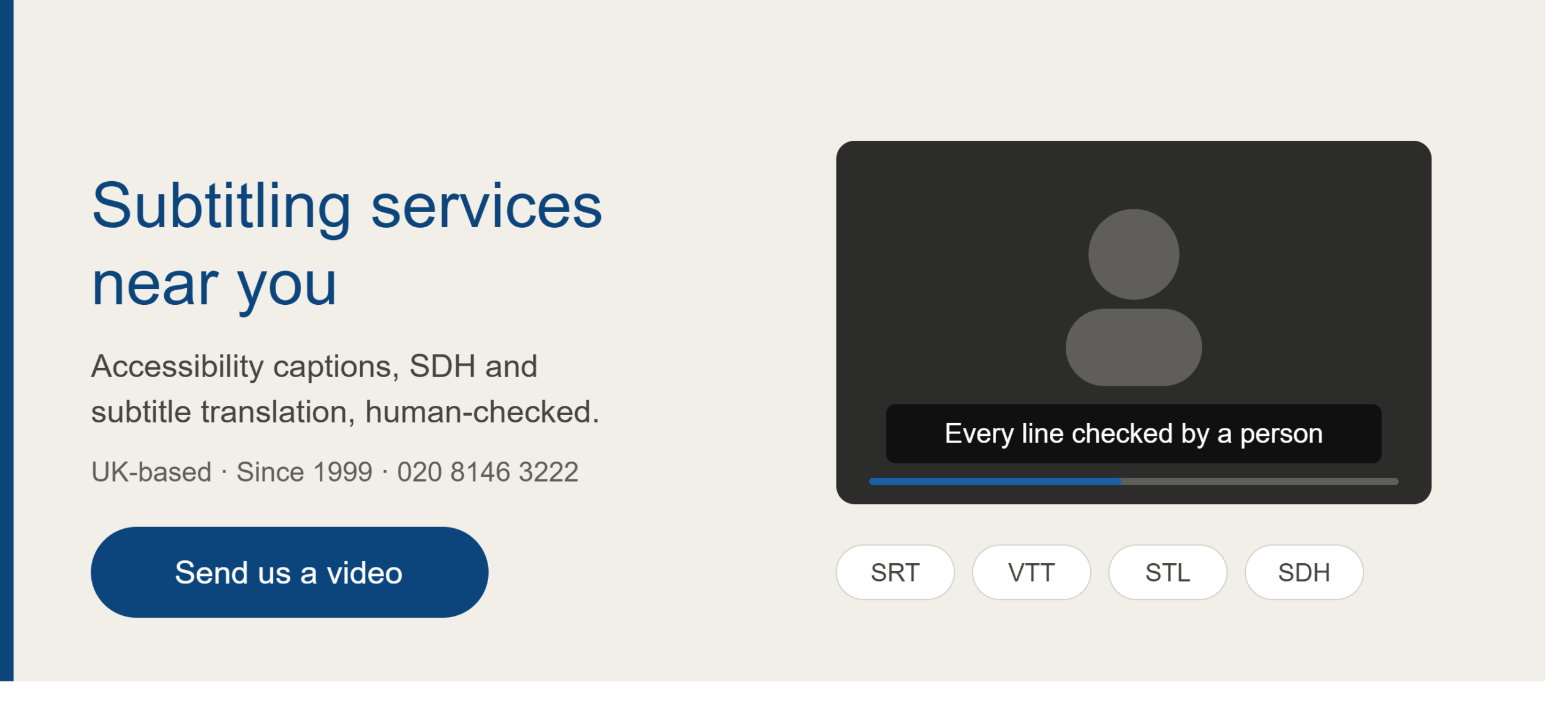
Accessibility captions, SDH and foreign-language subtitles for organisations that need them to be right rather than merely present. Delivered in every standard format, checked line by line by people.
Trust strip
- UK-based, since 1999
- SRT, VTT, STL, TTML and burned-in
- Human-checked, not auto-generated
- Free sample on your first file
Do you need a subtitling company near you?
Almost certainly not. Video files are sent and returned online, so a supplier two streets away and one two hundred miles away deliver identically. What matters is whether your subtitles meet the standard you are being held to, and whether a person has actually checked them.
If you searched for something nearby, you were probably looking for a UK supplier you could speak to — one that understands British spelling and terminology, works in your timezone, and can be held accountable if a delivery is wrong. That is a reasonable thing to want, and it is what we are.
We are a UK company, working from London since 1999, with a second office in New York. Your files stay under UK-controlled, GDPR-aligned handling, and you deal with a named contact rather than an upload form.
The Compliance Section — Lead Commercial Argument
Most organisations are legally required to caption their video. Most haven’t.
If your organisation publishes video, you are likely covered by at least one of the following:
Public Sector Bodies (Websites and Mobile Applications) Accessibility Regulations 2018. Public sector websites and apps must meet WCAG 2.2 Level AA. Under WCAG, captions are required on pre-recorded video at Level A and on live video at Level AA. This applies to councils, NHS bodies, police forces, colleges and most universities.
Equality Act 2010. The duty to make reasonable adjustments extends to how you communicate. Video without captions excludes deaf and hard-of-hearing users from information everyone else receives.
European Accessibility Act. Since June 2025, digital products and services sold into EU member states have had to meet its accessibility requirements. UK businesses selling into the EU are in scope.
Most organisations we speak to know this. What they usually have is a video library that was never captioned, or one captioned automatically and never checked.
The Auto-Caption Trap
Automatic captions are not the same as compliant captions
This is the point that catches organisations out. Turning on automatic captions produces something that looks like compliance. It very often isn’t.
Accessibility guidance is consistent on this: captions only count if they are accurate. Captions generated automatically and published without anyone checking them do not meet the standard, however good the underlying tool is.
Automatic captioning reliably struggles with the things that matter most in professional video:
- Names, job titles and organisation names
- Technical, clinical and legal terminology
- Regional accents and non-native English speakers
- Overlapping speech in panels, interviews and Q&A
- Speaker changes, which are frequently missed entirely
- Non-speech audio that SDH requires you to convey
None of these are edge cases in the kind of video most organisations publish. They are the normal content of a lecture, a board update, a training module or a public meeting.
Every subtitle file we deliver has been checked against the audio by a person, line by line. That is the whole point of using us rather than a button.
What We Deliver — Technical Specification Block
Closed captions and SDH Same-language subtitles for accessibility, including speaker identification and non-speech sound description where SDH is required.
Foreign-language subtitle translation Subtitles translated by human linguists and condensed to fit timing and character limits without losing meaning — the part automated translation consistently gets wrong. See also: Text Translation · Audio Translation
Burned-in (open) subtitles Permanently rendered into the video where your platform doesn’t support sidecar files, or where subtitles must always be visible.
Transcripts alongside subtitles A full transcript delivered with the subtitle file, which accessibility guidance often expects in addition to captions and which your users can search.
Delivery formats SRT · WebVTT · EBU-STL · TTML / DFXP · SCC · burned-in video
Subtitling standards we work to
- Two lines maximum, with line breaks placed at natural grammatical points
- Character limits per line set to your specification, typically in the 37–42 range
- Reading speed capped so subtitles remain readable
- Timings adjusted to respect shot changes
- Positioning moved where subtitles would obscure on-screen text
- Your house style guide, or platform requirements, applied throughout
Working to a broadcaster, platform or university specification? Send it with the first file and we will work to it.
Subtitles, captions and SDH — which do you need?
The terms get used interchangeably and mean different things in procurement documents.
| What it is | When you need it | |
|---|---|---|
| Captions | Same-language text of the dialogue | Accessibility compliance, sound-off viewing |
| SDH | Captions plus speaker IDs and sound description | Where full accessibility for deaf and hard-of-hearing viewers is required |
| Subtitles | Dialogue translated into another language | International audiences, multi-language releases |
If you need the spoken content of a recording as a document rather than as timed text on screen, you want transcription services instead. If you are unsure which applies to your project, send us the video and the requirement you have been given, and we will tell you.
Who we subtitle for
Universities and colleges with lecture capture, open-day content and course material subject to accessibility regulations.
NHS bodies and healthcare organisations publishing patient information, training and internal communications.
Councils and public bodies with committee meetings, public consultations and service videos.
Legal teams working with recorded evidence, depositions and disclosure video.
Corporate communications and L&D producing training modules, all-hands recordings and customer-facing video.
Research teams subtitling recorded fieldwork and interviews for archiving and publication.
Unreleased video stays unreleased
Much of what we subtitle is not public yet, and some of it never will be — internal briefings, recorded evidence, patient-facing material, embargoed announcements.
- Signed confidentiality agreements covering everyone handling your files
- GDPR-aligned processing throughout
- Encrypted transfer and secure storage
- No AI or automated transcription engines used to generate output
- Files deleted on request once work is complete
What subtitling costs
Priced per minute of video, depending on whether you need same-language captions, SDH or translated subtitles, plus audio complexity, speaker count and turnaround.
Insert your price-from figures here — ideally three: captions, SDH, translated subtitles. A named number materially improves conversion.
Back catalogue to caption? Volume pricing applies, and we can work through a library in scheduled batches rather than all at once. Tell us how many hours you’re sitting on and we’ll quote the programme.
Frequently asked questions
Do you have an office near me? Our UK operations are based in London, with a second office in New York. Video files are sent and returned online, so your location has no bearing on price, turnaround or quality.
What subtitle formats do you deliver? SRT, WebVTT, EBU-STL, TTML/DFXP and SCC, plus burned-in subtitles rendered into the video itself. Tell us your platform and we will advise which format it needs.
What is the difference between subtitles and captions? Captions are a same-language text version of the dialogue, used mainly for accessibility. Subtitles usually mean the dialogue translated into another language. SDH adds speaker identification and descriptions of non-speech audio.
Will your captions meet accessibility requirements? Our subtitles are produced and checked by people to the accuracy accessibility standards expect, and we work to whatever specification you have been given. We can advise on format and delivery, though we are not accessibility auditors and cannot certify your wider compliance.
Can’t I just use automatic captions? You can, but automatic captions published without human checking usually contain errors, and inaccurate captions do not satisfy accessibility requirements. Names, terminology, accents, overlapping speech and speaker changes are where they most often fail.
Do you use AI to generate subtitles? No. We do not use automated transcription engines to produce output. Technology supports secure file handling and delivery; the transcription, timing and checking are done by people.
Can you translate subtitles into other languages? Yes. Translated subtitles are produced by human linguists and condensed to fit reading speed and character limits, so the meaning survives the constraint. Tell us your target languages and we will confirm availability.
Can you work to our style guide or platform specification? Yes. Send it with the first file. Character limits, line-break rules, positioning conventions and speaker-ID formatting will all be applied as specified.
How quickly can you turn a video around? Turnaround depends on running time, speaker count, audio quality and whether translation is involved. You get a confirmed deadline before work begins, and expedited options are available.
We have years of uncaptioned video. Can you help with a back catalogue? Yes. We can work through a library in scheduled batches at volume pricing rather than doing it all at once. Send us the total running time and we will quote a programme.
Related Services:
 Clinical Transcription Services London
 Professional Voice Over Services
 Japanese Transcription Services
 Transcription Services Florida Near Me
 General Transcription Services (UK & Global)
 Transcription Services Near You — UK-Based, 100% Human
 Remote vs. In-House Assistant: What UK Professionals Should Know Before Hiring
 Media Transcription Services
 Best Podcast Transcription Service
 Certified Transcription Services
 Digital Transcription Services
 Insurance Transcription Services
 Podcast Transcription Services
 YouTube Video Transcription Service UK
 Conference Call Transcription Service

